
Rotary Evaporator
50L Rotary Evaporator Buying Guide for U.S. Cannabis Processors
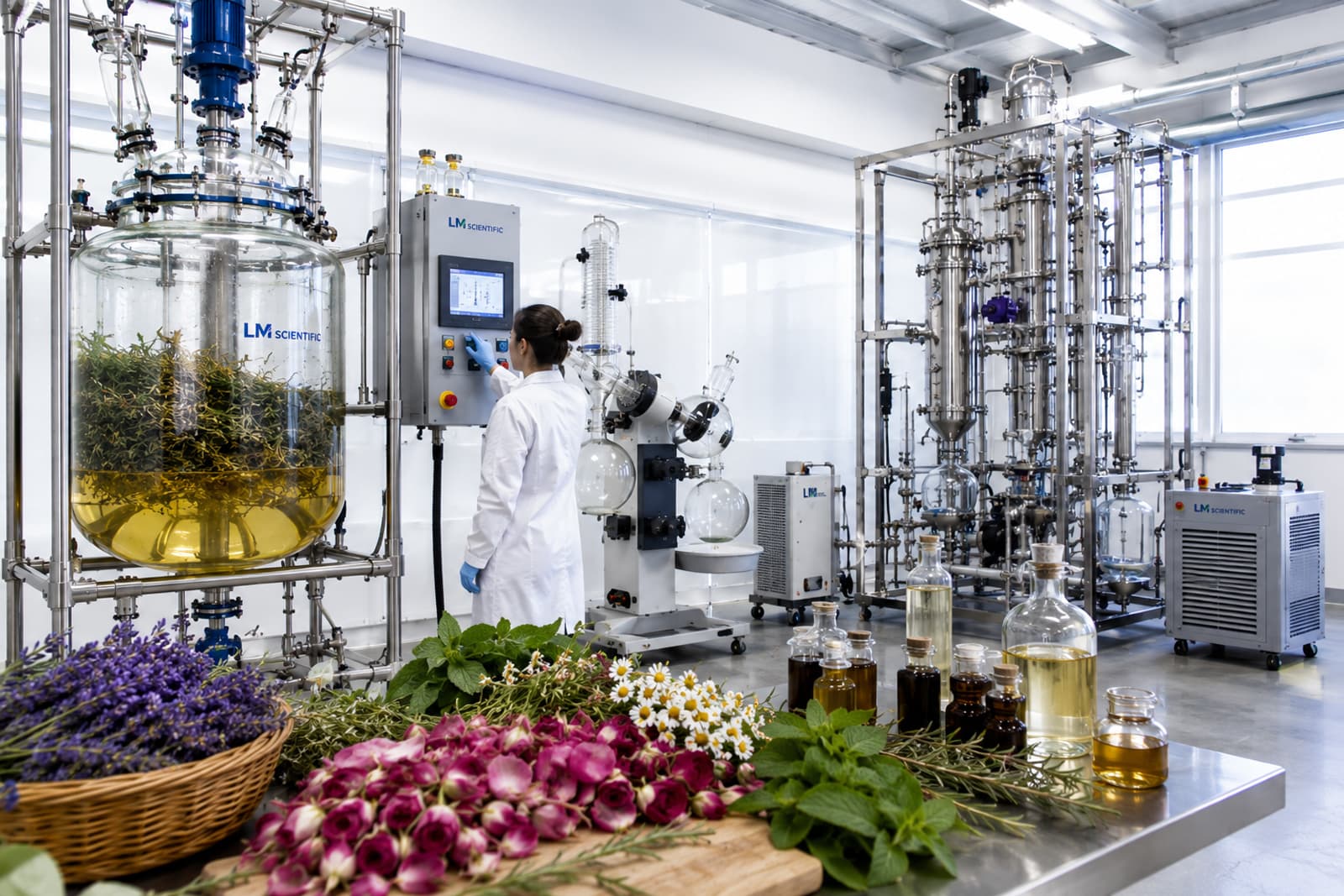
A 50L rotary evaporator (R1050 class) is the workhorse of U.S. cannabis and hemp ethanol recovery. It is large enough to deliver real throughput per shift, small enough to run on a standard 240V single-phase circuit, and flexible enough to swap between ethanol recovery, terpene recovery and solvent stripping without major reconfiguration.
This guide covers what actually matters when you specify a 50L rotovap for a U.S. facility — what to ignore in sales brochures, and where the real cost hides.
Quick answer
For a typical U.S. ethanol extraction facility processing 50-500 lb of biomass per week, a 50L rotovap should deliver:
- 9 L/hour water evaporation, 19 L/hour ethanol evaporation at bath temp 60 °C and chiller −10 °C
- Automatic motorized lifting (manual lifting is unsafe on 50L flasks when full)
- PTFE dual spin seal for high vacuum without oil contamination
- Explosion-proof (EX) option if installed in a C1D1 or C1D2 booth
- 220V 50/60Hz single-phase supply (step-up transformer needed on standard 120V)
Everything below explains why.
Step 1: Confirm your actual ethanol recovery throughput target
Sales brochures love to quote evaporation rate as a single number. Reality is that the rate depends on three variables:
- Solvent type — ethanol evaporates roughly 2x faster than water at the same bath temp
- Bath temperature — most cannabis labs run 55-65 °C to protect cannabinoids
- Chiller temperature and flow — if the chiller cannot pull condenser temp down to −10 °C, effective rate drops fast
A 50L rotovap with a matched −10 °C chiller delivering 15 L/min flow will typically recover 15-19 L of ethanol per hour in steady operation. If your chiller can only hold −5 °C under load, expect 30-40% lower throughput.
Buyer tip. Always size the chiller capacity (W at −20 °C) at 1.5x the rotovap’s peak evaporation rate. Under-spec’d chillers are the single biggest source of disappointed cannabis customers.
Step 2: Match the chiller
The 50L rotovap does not work alone. Typical U.S. cannabis pairings:
| Rotovap | Recommended Chiller | Chiller Temp | Notes |
|---|---|---|---|
| R1050 (50L) | DLSB-30/80 | −80 °C capable, used at −20 °C | Standard workhorse |
| R1050 (50L) | DLSB-50/80 | −80 °C capable, used at −20 °C | Higher flow, faster recovery |
| R1050 (50L) | DLSB-100/40 | −40 °C capable | Cheaper, fine if you never need deep cold |
For ethanol recovery alone you don’t need −80 °C — you need stable −10 °C to −20 °C under load. The −80 °C rating buys you headroom for winterization in a separate reactor.
Buyer tip. Ask the supplier for the chiller’s cooling capacity curve (W vs coolant setpoint). A chiller rated “8,000 W at −10 °C” may only deliver 3,000 W at −20 °C.
Step 3: Decide on explosion-proof configuration
Ethanol is a Class I flammable liquid. U.S. cannabis facilities typically install extraction equipment in one of three ways:
- C1D1 booth. All electrical equipment must be explosion-proof. Specify the EX version of the rotovap with EX motor, EX control box and EX lifting mechanism.
- C1D2 extraction room with forced ventilation. Some jurisdictions allow standard equipment with interlocked ventilation. Confirm with your local AHJ (authority having jurisdiction).
- Non-hazardous lab. Standard rotovap is fine. Solvent inventory must stay below jurisdictional thresholds.
The explosion-proof premium on a 50L rotovap is typically 25-40% over the standard version. This is a real cost — get the AHJ determination before you order, not after.
Step 4: Lifting, controls and user experience
The R1005 and R1006 (5L, 6L) can run with manual lifting. The 50L cannot. A full 50L flask of ethanol-cannabis crude weighs 45+ kg — manual lifting is unsafe and slow.
Confirm the following on the 50L:
- Automatic motorized lifting with 0-180 mm travel
- LCD display for vacuum, rotation speed and bath temperature
- DC speed regulator (not AC) for smooth control at low rotation speeds
- Continuous receiving — the spec to look for is “continuous receiving without breaking vacuum”
Step 5: Voltage and U.S. installation realities
LM Scientific’s R1050 is rated 220V 50/60Hz single-phase. U.S. standard residential is 120V; U.S. commercial buildings typically have 208V or 240V available.
Three common U.S. installation patterns:
- 240V single-phase — easiest; works directly, maybe with a simple plug change
- 208V commercial — works but slightly lower heating power; plan bath temp a bit higher
- 120V only — requires a 3-5 kVA step-up transformer; most customers upgrade the circuit instead
Budget item. Add $300-600 for a proper step-up transformer if needed. A 50L rotovap pulls 6.3 kW at peak.
Total landed cost checklist
Here is what a typical U.S. 50L rotovap deployment costs beyond the unit price:
| Item | Typical cost |
|---|---|
| R1050 50L rotary evaporator (standard) | $5,000 ex-works |
| R1050 EX explosion-proof premium | +30% |
| Matched DLSB-30/80 chiller | $6,500 ex-works |
| SHB-B95 vacuum pump | $460 ex-works |
| Ocean freight Zhengzhou to U.S. West Coast | $800-1,400 for a shared container portion |
| Customs duty (HTS 8419) | 2.6% of declared value |
| Port-to-door trucking | $400-900 depending on zip |
| Step-up transformer (if needed) | $300-600 |
| Spare PTFE seals (recommended) | $150 |
A typical 50L + chiller + pump deployment lands in the $14,000-17,000 range for standard configuration, or $18,000-22,000 with EX option.
Frequently asked questions
Is a 50L rotovap big enough for commercial cannabis operation? Yes, for facilities processing up to about 500 lb of biomass per week. Above that, either run two 50L units in parallel or step up to a falling-film evaporator.
How long does a 50L rotovap from China take to arrive? Ex-works lead time is typically 2-4 weeks. Ocean freight from Zhengzhou to U.S. West Coast is 30-40 days; East Coast 40-50 days. Plan 8-12 weeks door-to-door.
What is the expected service life? With proper maintenance (seal replacement every 12-18 months, bath oil changes, avoiding chlorinated solvents), a 50L rotovap is productive for 8-12 years.
Can I run ethanol recovery and terpene recovery on the same unit? Yes, but plan on a separate condenser train for the deep-cold terpene work. Terpenes condense around −40 °C and need a dedicated cold trap.
Next step
Share your facility voltage, hazardous location classification and target weekly throughput with the LM Scientific team. We will propose a matched 50L rotovap + chiller + pump configuration with U.S.-delivered pricing and estimated arrival timeline.